
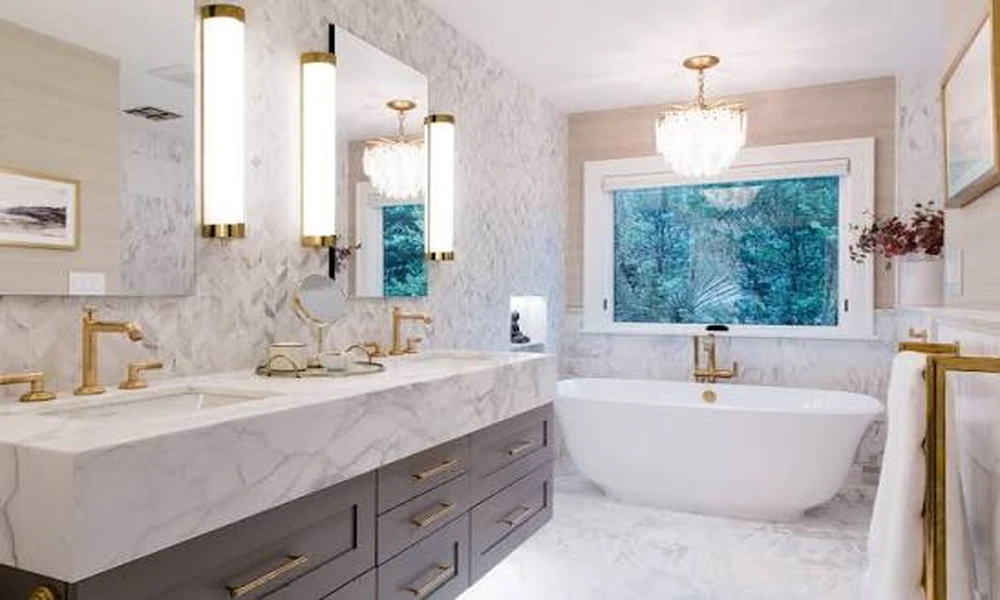
The vanity has quietly become the most expressive element in a modern bathroom. It sets the tone the way a sofa anchors a living room, and the design conversation around it has moved fast. Looking at what manufacturers are pushing and what renovators are actually installing, a few clear directions stand out. Here is where the bathroom vanity appears to be heading, and why each shift makes practical sense rather than being pure fashion.
1. Floating profiles become the default, not the statement
Wall-mounted vanities used to read as a bold design choice. That is fading. Floating profiles are becoming the expected look, and the reasons are functional as much as stylistic. Lifting the cabinet off the floor makes a bathroom feel larger, simplifies cleaning underneath, and adapts the counter height to the people who actually use it.
Expect this to keep spreading, especially in smaller bathrooms where the visual lightness pays off most. Browsing a broad collection like the range of Entrepôt de la Réno bathroom vanities shows how far floating profiles have moved into the mainstream. The main constraint is structural, since a floating unit needs solid wall backing to carry its weight and daily use, so more renovators now plan for that backing during framing rather than treating it as a special request.
2. Integrated and seamless basins take over
The second shift is about the join between counter and sink. Designers are steadily eliminating it. Integrated basins, molded from the same material as the countertop with no seam at all, are gaining ground because they solve a real problem: the crevice where the sink meets the counter is exactly where grime and water damage collect.
A seamless top wipes clean in one motion and has no vulnerable joint to fail over time. The look is minimalist, but the driver is maintenance. As solid-surface and quartz options become more affordable, the integrated basin stops being a luxury detail and becomes a sensible default for anyone who values easy upkeep, which is nearly everyone.
3. Storage gets smarter, not just bigger
Storage is being rethought from the inside. The trend is away from a big empty cabinet with a single shelf and toward intelligent interiors: drawers that notch around plumbing, built-in dividers, hidden outlets for charging and grooming tools, and soft-close hardware as a baseline rather than an upgrade.
This reflects how people actually use a vanity, cramming a chaotic mix of small items into it daily. Deep drawers that reveal everything at a glance beat cupboards where things disappear to the back. Increasingly, the smarter interiors are what separate a merely attractive unit from one that genuinely improves the daily routine.
4. Warmer materials push back against all-white
The all-white bathroom had a long run, and it is not disappearing, but it is getting company. Warmer woods, matte earth tones, and richer finishes are returning to the vanity specifically, bringing texture and warmth to a room that had drifted toward the clinical. The vanity is the natural place for this, since it is the largest piece of furniture in the space.
This is partly a reaction and partly practical. Warmer, textured finishes hide water spots and daily wear better than stark high-gloss white, which shows every mark. So the move toward warmth serves both the eye and the reality of a heavily used room. Expect wood-look and muted tones to keep gaining as people tire of the gallery-white aesthetic.
5. Modular and made-to-fit options expand
The last shift is about fit. Standard sizes never suited every bathroom, and the market is responding with more modular systems and adaptable widths. Rather than forcing an awkward space to accept a fixed unit, renovators increasingly assemble a vanity that matches the exact wall it lives on.
This matters most in older homes and unusual layouts, where a standard box leaves dead space or blocks a door. As manufacturing gets more flexible, the made-to-fit vanity becomes accessible at ordinary price points rather than custom-only budgets. The result is bathrooms that use every inch instead of surrendering some of it to a size that almost fit.
What these shifts mean for the countertop and hardware
The vanity does not change in isolation. As the cabinet evolves, the surfaces and details around it move too, and ignoring that connection leaves a project feeling half-finished. Countertops are trending toward materials that support the seamless, low-maintenance direction: quartz for its durability and consistency, and integrated basins molded right into the surface. The days of a fussy tile countertop with grout lines around the sink are fading for good reason, since that surface was always a maintenance headache.
Hardware is having its own quiet moment. As warmer vanity finishes return, the pulls and knobs are shifting to match, with matte black, brushed brass, and warmer metals replacing the ubiquitous polished chrome of the past decade. The trend is toward hardware that reads as a deliberate accent rather than an afterthought, and toward integrated or edge-pull designs that keep the clean floating profile uninterrupted.
Faucets complete the picture, and they are following the same logic. Wall-mounted faucets pair naturally with vessel and integrated basins, freeing the counter surface and reinforcing the minimalist look. Finishes are coordinating across the whole assembly, so the faucet, the hardware, and any visible fixtures speak the same design language. The takeaway for a renovator is to design the vanity as a system rather than a single object. Choosing a forward-looking cabinet and then bolting on dated hardware or a mismatched faucet undercuts the whole effect. The pieces are converging, and the best results come from letting them.
Reading the direction
Pull these five shifts together and a theme emerges. The bathroom vanity is being redesigned around how people really live with it: easier to clean, smarter to store in, better fitted to the room, and warmer to look at. These are not arbitrary style swings. They are answers to genuine frustrations with the vanities of the past decade.
For anyone planning a bathroom now, the practical move is to lean toward these directions rather than against them, because they tend to age well. A floating, seamless, smartly organized vanity in a warm finish is not chasing a trend that will look dated in five years. It is solving problems that will still be problems long after the current color of the moment has moved on.
For anyone renovating now, the safest bet is to design toward these directions rather than against them. Trends that solve real problems, easier cleaning, smarter storage, better fit, tend to become the new baseline rather than fading. A vanity chosen with these shifts in mind is less likely to feel dated in a few years, because it is answering needs that will not disappear when the current palette of the moment moves on.